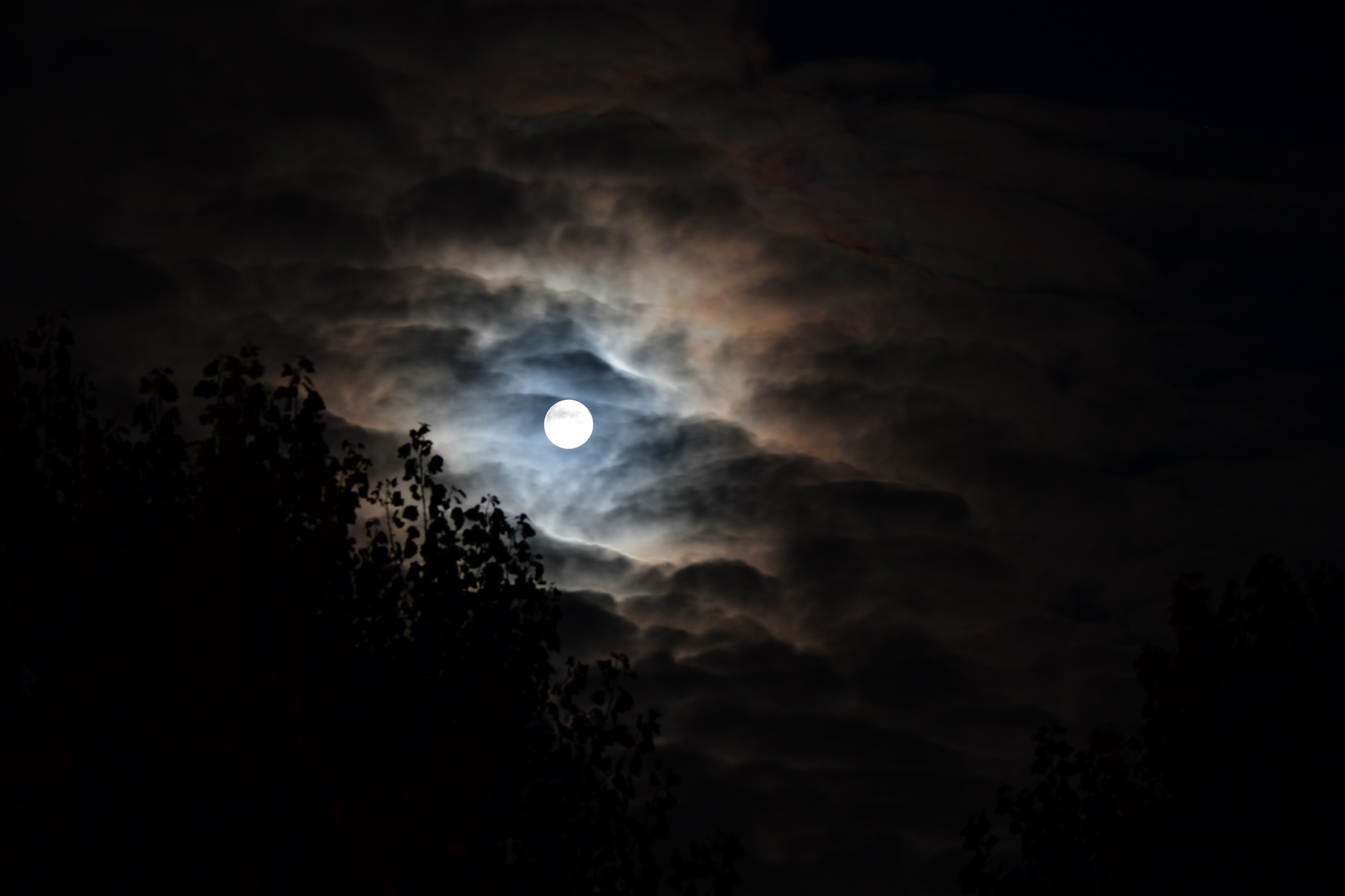
The archaeology of your own influences is always the most surprising dig.
I was looking at the full moon one night, clouds nested around it, and remembered Nietzsche's eternal return.
Holy fuck, I thought. That's what I've been writing.
I'd started writing Anamnesis just to see if I could — came up with the characters, the worldbuilding, the magic system. It began as a synthesis of all the romantasy tropes I enjoyed reading — Fourth Wing, ACOTAR, Throne of Glass, and more. But it only really took off that night, standing under the moon.
I went inside and started researching the eternal return. Immediately, I found an article talking about Nietzsche's thought experiment:
“What if some day or night a demon were to steal after you into your loneliest loneliness, and say to you, ‘This life as you now live it and have lived it, you will have to live once more and innumerable times more; and there will be nothing new in it, but every pain and every joy and every thought and sigh and everything unutterably small or great in your life will have to return to you, all in the same succession and sequence…’ Would you not throw yourself down and gnash your teeth and curse the demon who spoke thus? Or have you once experienced a tremendous moment when you would have answered him: ‘You are a god and never have I heard anything more divine.’”
It's from The Gay Science. And it's been living rent-free in my head ever since. It turned a trope-filled romantasy into something completely different.
I read a little Nietzsche when I was in uni. Thought I knew the shape of his philosophy. Knew the main points — died of syphilis (he didn't), cried with horses, God is Dead, got co-opted by the Nazis. Didn't love him.
I think I needed to be older and wiser before he broke me open with these pointing-out instructions.
I've finished the novel. It's long. I need to cut it back by approximately half for a publishing house to even consider it as a debut. That's where I am now.
But last night I thought: if one Nietzsche quote can help me write a 147K-word novel, what would the whole book do?
I flicked to the internet and found a YouTube video about The Gay Science. Thought I'd get the lay of the land before I dove into the book. I lasted around one minute.
Because the video started explaining what the title meant. And I discovered that I'd followed a thread from a single Nietzsche quote — the eternal return demon, the will you live this again and again — without knowing that Nietzsche himself was in conversation with the troubadours when he wrote it.
Die fröhliche Wissenschaft — The Gay Science — takes its title directly from the gai saber, the Occitan term for the troubadour art of poetry. Nietzsche was obsessed with Provençal culture, saw the troubadours as the last Europeans who'd genuinely affirmed life rather than fled from it, and the eternal return is, in many ways, his attempt to secularise and radicalise what the troubadours were doing mystically.
Then I wondered: do any of the troubadour stories map onto Anamnesis? Off I went down another rabbit hole.
Turns out that several map onto it with startling precision, and one in particular feels like it might be the mythological skeleton Anamnesis has been unconsciously building toward.
Jaufré Rudel and amor de lonh
Rudel was a 12th-century troubadour who wrote a cycle of poems about a woman he'd never met — a love from afar, across impossible distance, that he considered more real and more true than any love available to him in proximity. He eventually sailed to find her and died, according to legend, in her arms upon arrival — the moment of finding her being inseparable from the moment of ending.
The structural parallel to Riven in Anamnesis is almost exact. A love that exists across distance so vast it defies ordinary logic. A devotion that doesn't diminish with absence but calcifies into something geological. The beloved who is always just across a distance that can't be closed — except that in Anamnesis the distance is time rather than geography, and the moment of full arrival keeps being deferred by death. Riven has been sailing toward Lyre for six hundred years and keeps arriving just as she's leaving.
The Cathar connection and metempsychosis
This is where the archaeology gets genuinely interesting. The troubadours flourished in Occitania in the same period and region as Catharism, and the overlap is not coincidental. Denis de Rougemont argued in Love in the Western World that fin'amor was essentially a coded mystical practice. That the troubadour poems weren't really about a woman at all but about the soul's yearning to escape the cycle of material existence.
The Cathars believed in metempsychosis — souls trapped in matter, returning through successive lives, accumulating toward eventual liberation. De Rougemont's thesis is that the troubadour beloved is not a person but a destination: the soul's longing for its own completion, projected outward onto an impossible object of desire.
In Anamnesis, Riven literally believes this and is literally living it. The eternal return mechanism isn't metaphor — it's the actual structure of his existence. What de Rougemont describes as the unconscious theology of troubadour poetry is the explicit mythology of my book.
And I didn't even know until I finished writing it.
De Rougemont spends most of Love in the Western World on the Tristan myth, and his reading lands uncomfortably close to my own love triangle — Caelan as the principle of legitimate order, the person the beloved is structurally bound to, whose existence makes the other love feel both transgressive and inevitable. And in the troubadour alba tradition, lovers separate at dawn before the world catches them. Lyre memorising Caelan in the pre-dawn dark has this exact structure, except the night belongs to the wrong man. She's performing the alba with Caelan when the alba-feeling belongs to Riven.
But those are threads I'll pull in future essays. The parallel that matters most here is de Rougemont's central claim: that Western romantic love is structurally death-seeking. That the obstacle is not incidental to the love story but constitutive of it. That we desire most intensely what we cannot have. His phrasing: happy love has no history.
Riven's arc across the trilogy is, among other things, the story of what happens when a troubadour love is finally forced to confront happiness. Six hundred years of amor de lonh, and then the moment — in Book 2 or 3 — when the distance closes and the question becomes whether the love can survive its own fulfilment. That's a more interesting problem than the love triangle, and it's the question de Rougemont might say my whole trilogy is actually asking.
The demon's hour
What strikes me reading that first Nietzsche quote now, having written Anamnesis, is that Nietzsche frames it as a binary — curse the demon or call him a god. The test of whether you've lived well enough to want the repetition.
Riven has lived the repetition without being asked. He didn't get the choice. The demon came for him not as a hypothetical but as a fact, and the question my story is actually asking isn't Nietzsche's question — would you choose this — but the question that comes after it: what does a person become when the choice is made for them, across six hundred years, and they keep showing up anyway?
That's perhaps a harder question than Nietzsche posed. And definitely a more human one.
Because the quote has a hidden assumption — that the person being asked is the same person each time. Nietzsche's eternal return is a thought experiment about a single consciousness confronting infinite repetition. But Lyre isn't the same person each cycle. She's born new, without the memory, without the weight. The demon's terms don't apply to her the way they apply to Riven. He carries all of it. She carries none of it.
So Riven is the one cursing the demon and calling him a god simultaneously, every single time. Six hundred years of both at once. That's not Nietzsche's binary. That's something the quote gestures toward but doesn't have the narrative architecture to explore.
I think maybe it needed a novel.
The other thing worth sitting with: the demon steals into your loneliest loneliness. Not your joy. Not your triumph. Your loneliest loneliness. Nietzsche understood that the eternal return only becomes a real question when you're alone enough to hear it clearly. And my novel's coda — Riven alone, watching Lyre sleep, interrogating whether Caelan's intervention was accident or design — is precisely that. The demon's hour. The loneliest possible moment to ask: is this divine or is this a curse?
And Riven's answer, six hundred years in, is still: both. Always both.
That ambivalence is everything. Nietzsche wanted a clean yes — the amor fati, the love of fate, the full-throated affirmation. Riven can't give that and wouldn't be honest if he did. He keeps coming back not because he's answered the question but because he can't stop asking it.
That's the troubadours, too, in the end. Not resolution. Just the song, sung again. And again. The eternal return of the story of our lives.
P.S. I keep coming back to the image at the top of this post. The moon nested in cloud like a pupil in an iris. A single eye looking down. And I think about a consciousness vast enough to fracture itself into pieces just so it could experience longing — so there could be a distance to cross, a song to sing, a lover to sail toward. Happy love has no history. Maybe that's not a tragedy. Maybe that's the reason for the fracture.
The Anamnesis Trilogy is a dark romantasy about power, memory, and the architecture of the self. Book One is coming soon. Join the newsletter for early excerpts and craft notes.
Join the Newsletter